


Calmer first steps, without another rigid brace
Soft zoned compression that supports your fascia through the night and your whole shift, so mornings stop starting with a stab. No plastic, no straps holding your foot hostage.
- Gentle support against overnight tightening
- Thin enough to wear under work socks
- Soft enough to sleep in, no straps, no bulk
- Backed by the 30 Day First Step Guarantee
| Size | US Women's | US Men's |
|---|---|---|
| S / M | 5 to 9.5 | 5 to 8 |
| L / XL | 10 and up | 8.5 to 13 |
Couldn't load pickup availability
The 30 Day First Step Guarantee. Wear it to work. Walk in it. Sleep in it. If your first steps out of bed do not feel different within 30 days, we refund you in full. You do not even need to send it back.
Free tracked shipping.
How is this different from compression socks I have tried?
Most compression socks squeeze everything evenly. This sleeve uses zoned compression that targets the arch and heel, where your fascia actually needs the support, while leaving your toes free to move and do their job.
Can I really sleep in it?
Yes. That is the point. It is soft fabric with no straps, no boards, and no bulk. Nothing to grab the covers or get ripped off at 2 AM.
What if it does not work for me?
Then it costs you nothing. If your mornings have not changed in 30 days, you get a full refund.
When will it arrive?
Orders are processed in 1 to 3 business days and typically arrive within 7 to 15 business days with tracking the whole way.


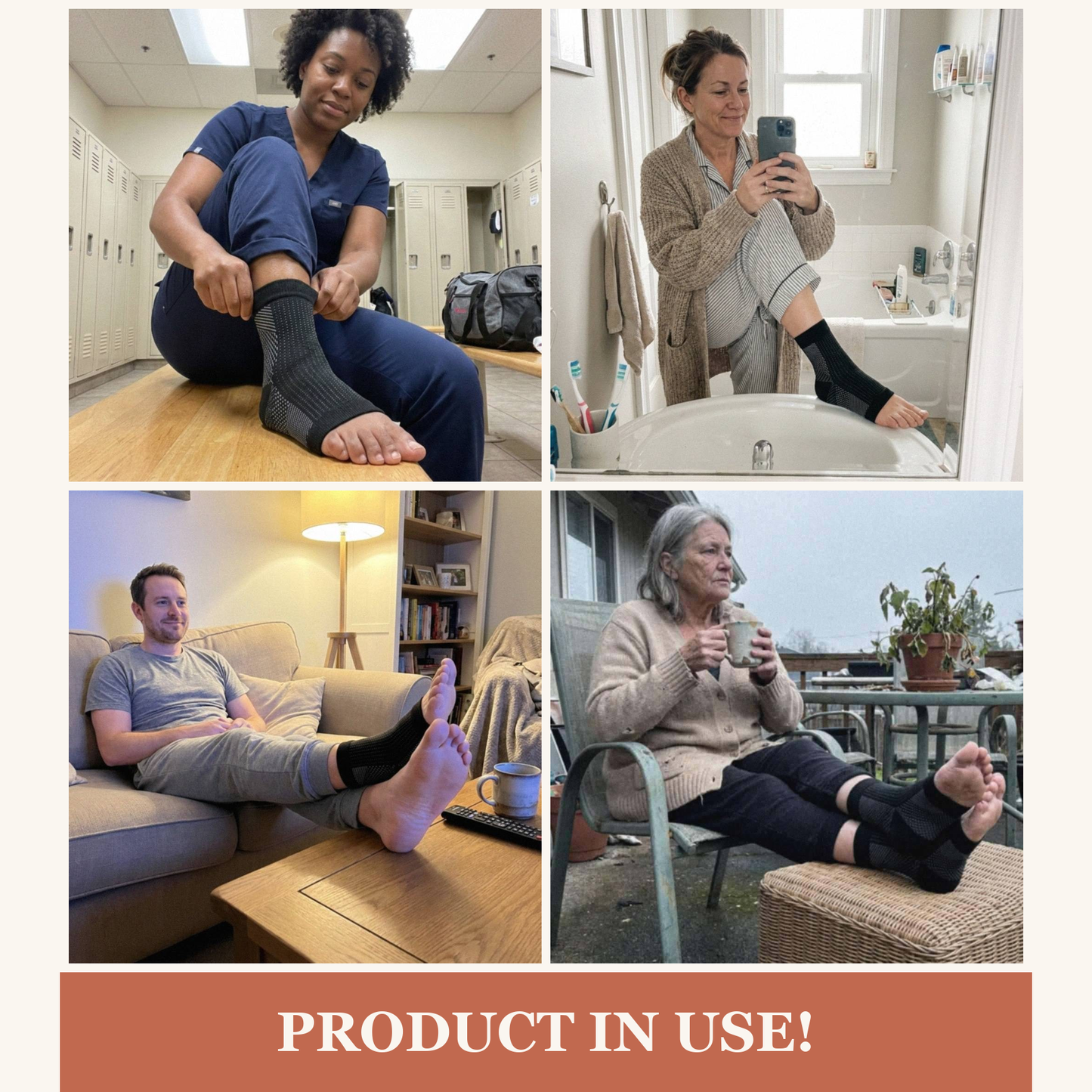
You are awake before your alarm, dreading the floor
It is the strangest kind of pain. You have been resting all night. Your foot should feel better. Instead you lie there, working up the nerve for those first steps, because you know exactly what is coming.
Here is what is actually happening. While you sleep, the band of tissue along the bottom of your foot slowly tightens and contracts. Then your full body weight lands on it, cold, in one step. The tissue stretches too far, too fast, and tears a little. That stab you feel is real. And because it happens every night, it resets every single morning.
Your mornings are not the problem. They are the symptom. The real problem is that your fascia is doing a job it was never meant to do alone.
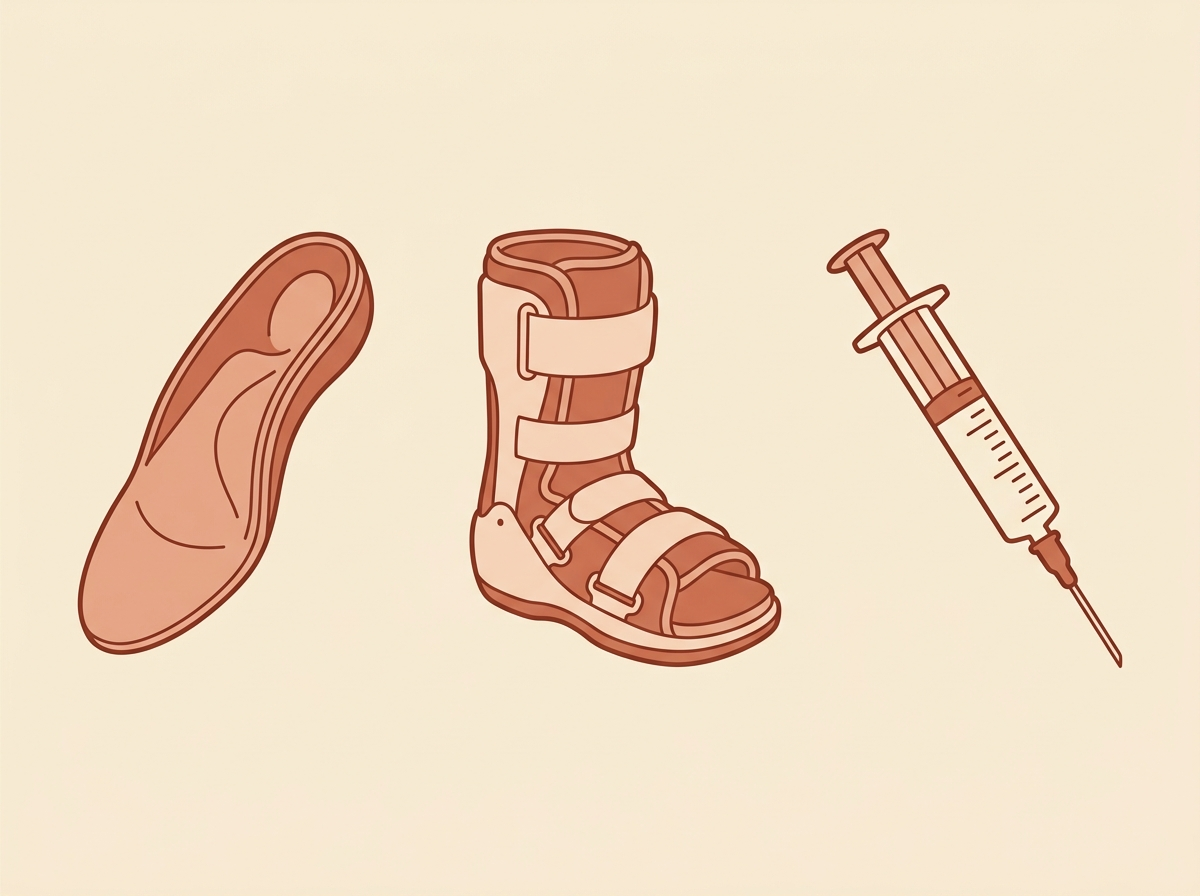
The rigid gear failed you, not the other way around
If you have spent money on this pain before, you already know the ladder. The $400 to $600 custom orthotics with no refunds. The night splint that felt like sleeping in a ski boot, grabbing the covers until you ripped it off at 2 AM. Maybe a cortisone shot that wore off, or left things worse than it found them.
People in heel pain forums say it plainly. They paid out of pocket for custom inserts that ended up making the pain worse. They hated the splint, their toes went numb, and they pulled it off in the middle of the night.
Here is the part nobody told you. All of that gear shares one idea: hold the foot still. And holding the foot still is exactly what keeps it weak. A foot in a rigid brace is like an arm in a cast. The muscles stop working, they fade, and the fascia is left carrying every single step alone.
You did not fail those treatments. Those treatments fight your foot's own design.
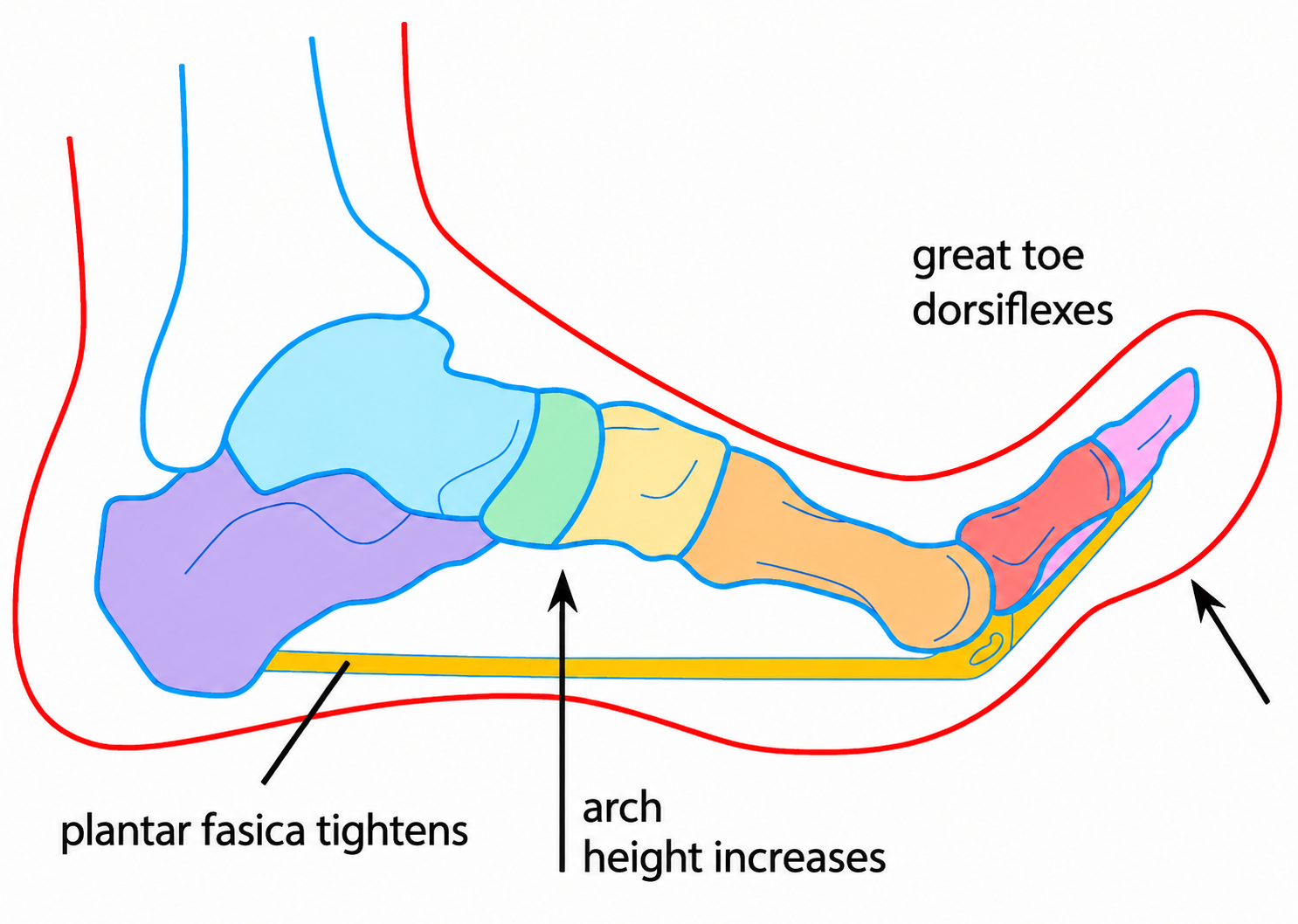
The windlass mechanism: the big toe winds the fascia, and the arch lifts itself.
Your foot is a spring that winds itself
In 1954, a researcher named J.H. Hicks discovered something remarkable about the human foot. It is not a static arch that needs propping up. It is a self tensioning pulley system, which he called the windlass mechanism.
Every time you push off a step, your big toe bends upward and winds the fascia tight, like a cable on a winch. That cable pulls your heel and toes closer together, and your arch lifts itself. No conscious effort. No plastic insert. Your foot has been designed to support itself with every step since before you could walk.
But the mechanism only works if the foot is free to move. Stiff shoes, rigid inserts, and bulky braces stop the winch from turning. The muscles that should share the load fall asleep. And the fascia frays like a cable doing the work of ten.
- Your big toe bends upward as you step
- The fascia winds tight like a cable on a winch
- Your arch rises and carries the load itself
As Harvard evolutionary biologist Dr. Daniel Lieberman put it, people are relying on their plantar fascia to do what muscles normally do.
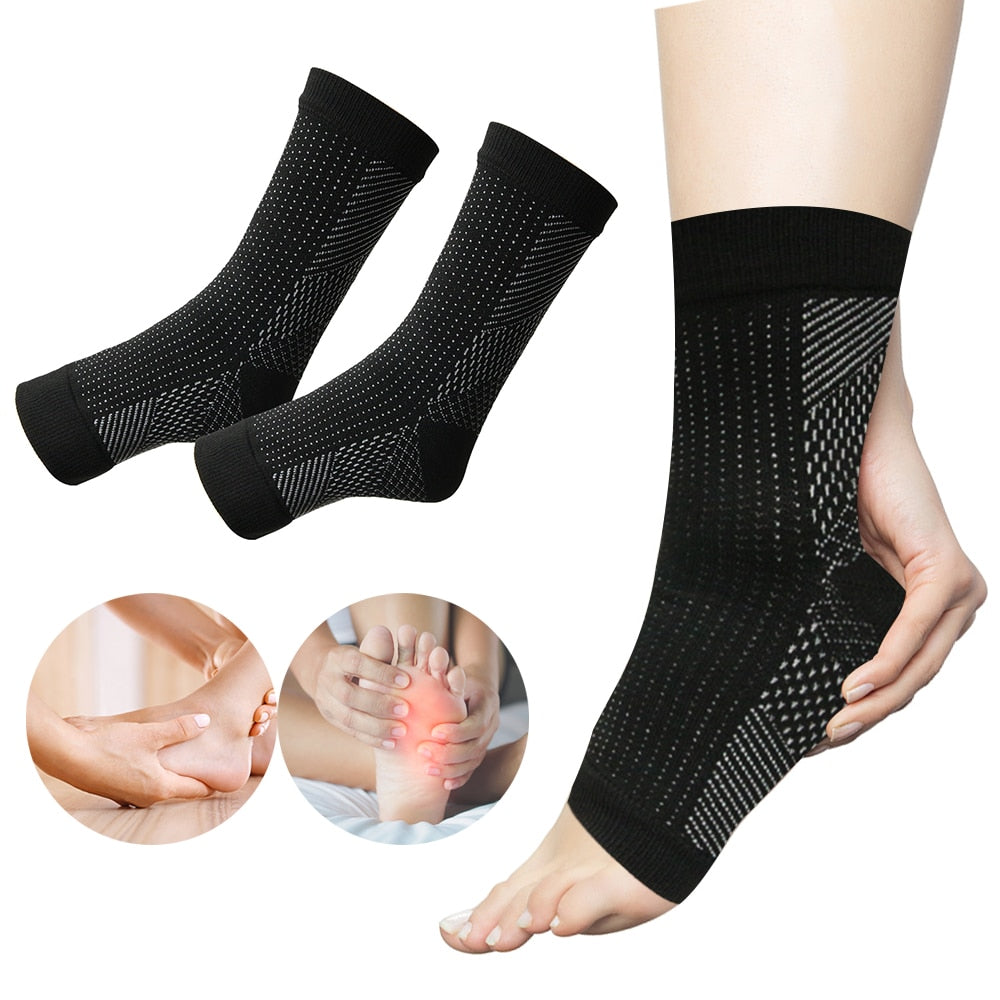
Soft support that works with your foot, not against it
The Morning Sole Recovery Sleeve was built around one rule: support the fascia without switching off the spring.
Zoned graduated compression holds the tissues under your arch and around your heel gently aligned. Through the night, that means less contraction and tightening, so your first steps land on tissue that is ready for them. Through the day, the load is shared while your toes and arch stay free to flex, keeping the windlass engaged.
It is a light, moisture wicking weave that stays breathable through a full shift, with an open toe so your toes stay free to flex, and it is shaped left and right so it actually fits the foot it is on. No boards. No plastic. Thin enough to disappear under your work socks and soft enough to sleep in.
Engineered zone by zone
Targeted arch zone
Firm, gentle hold exactly where the fascia needs it.
Cushioned heel cradle
Support wrapped around the point of impact.
Free toe box
Your windlass stays switched on, not locked down.
Breathable weave
All day wear under socks without the swelter.
Made for your exact kind of foot pain
If any of these is your morning, this was built for you.
Morning first-step stabs
The classic plantar fasciitis heel pain the moment you stand up.
Plantar fasciitis
Overnight support that eases the tissue you re-tear every morning.
Heel spur pain
Cushioned support around the heel where the ache lives.
Aching arches
Targeted arch compression that shares the load your fascia carries alone.
End-of-shift burning
Wear it under work socks so hour twelve feels less like hour twelve.
On your feet on hard floors
For nurses, teachers, retail and trades who cannot just sit down.
The best support is the one you actually keep on
Overnight
Gentle alignment while your fascia would normally tighten.
First steps
Calmer mornings, because the tissue is supported before your feet hit the floor.
On shift
Load sharing through the hours on hard floors that light the pain back up.
“One of the biggest problems in the world today of people's feet is plantar fasciitis. We think that people are relying on their plantar fascia to do what muscles normally do.”
Dr. Daniel Lieberman, Harvard University
How it compares to everything you have tried
| Morning Sole Sleeve | Rigid orthotics | Night splint | Cortisone shot | |
|---|---|---|---|---|
| Lets your foot move naturally | ✓ | No, locks the arch | No, locks the ankle | No effect on mechanics |
| Comfortable enough to sleep in | ✓ | Not made for sleep | Most give up on it | Not applicable |
| Works day and night | ✓ | Day only | Night only, if you last | Wears off |
| Risk to your body | None | Can shift pain to knees and hips | Numb toes, lost sleep | Tissue damage with repeat shots |
| Typical cost | Under $75 a pair | $400 to $600, often no refunds | $50 to $150 | Copays, per shot |
| Money back guarantee | 30 days, full refund | Rarely | Rarely | Never |
Every claim here traces to documented failure modes and pricing. Categories only, no brand names.
For the feet that cannot call in sick
Nurses on hour twelve of a shift. Teachers who stand at the whiteboard all day. Retail and food service workers on concrete. Builders, hairdressers, homemakers, and the runners who refuse to stop. The advice to just rest and stay off your feet was never written for you.
Morning Sole is built for people who have to keep moving, and whose recovery has to happen inside a real life: on shift, on hard floors, overnight, and out the door again by seven.
A fraction of one orthotics fitting
This market has been burned. $400 to $600 for rigid inserts with no returns. $150 splints in the back of the closet. Nobody should have to gamble half a paycheck to find out if something helps.
So the math here is simple. One pair costs less than a single copay ladder visit. Two pairs means one to wash and one to wear, so support never takes a day off. Three pairs covers you full time with a spare in your work bag. And every option carries the same guarantee: if your mornings do not change, you pay nothing.
Complete the recovery kit. Pair the sleeve with the acupressure massage roller for tired arches at the end of a shift, and gel insoles for your work shoes. Support on your foot, relief after hours, and cushion under every step.
The 30 Day First Step Guarantee
We measure our product where you measure your pain: the first steps out of bed.
Wear the sleeves for 30 days. Work in them, walk in them, sleep in them. If your first steps of the morning do not feel different, email us and we refund every cent. No return shipping, no forms, no arguing.
We can offer this because of what it replaces: an industry that charges $500 and refuses returns. Being the opposite of that is the whole point of this brand.
Guarantee window starts the day your order arrives. One refund per household.
Questions, answered honestly
I have tried compression socks before and they did nothing. Why would this be different?
Generic compression socks squeeze the whole foot evenly, which mostly helps circulation. This sleeve is zoned: firmer targeted hold under the arch and around the heel where the fascia attaches, lighter everywhere else, with the toes left completely free so the foot's natural mechanics keep working. Different tool, different job.
Is this just a sock for $40?
It is a zoned compression sleeve, sold as a pair, engineered around a documented mechanism, and backed by a guarantee that pays you if it fails. The rigid insert industry charges ten times as much and refuses refunds. We would rather be judged against that.
My case is severe. Nothing has worked. Be honest, will this?
Honestly: we do not know your foot, and anyone who promises a cure is lying to you. What we can say is that the sleeve is built on sound mechanics, it is comfortable enough to actually use day and night, and the guarantee exists precisely so that trying it is not another gamble. If it does not help you, it costs you nothing.
Can it fix damage that is already there?
No product like this can undo structural damage, and we will not pretend otherwise. The sleeve supports recovery: it reduces the overnight tightening that makes mornings brutal and shares the load during the day so the tissue gets a fairer chance to settle. For anything beyond that, see a professional you trust.
Will it be comfortable enough to sleep in?
Yes. It is soft, thin, and strapless. Nothing grabs the sheets, nothing presses on nerves, nothing to rip off at 2 AM. Most people forget it is on.
What if it is too tight or the size is wrong?
Check the size chart in the photos. If you land between sizes or get it wrong, we exchange it free. Compression should feel snug and supportive, never numb or tingling. If you feel pins and needles, size up.
Why not just buy a cheap one online?
You can, and some people do, and then they are back on the forums a month later. The difference is zoned design instead of even squeeze, a pair instead of a single, a brand that answers email, and a guarantee measured on your mornings. Cheap is only cheap if it works.
My doctor told me to rest and get orthotics. Should I ignore that?
No. Keep listening to your doctor, and tell them what you are trying. But you already know rest is not realistic on a working schedule, and you may already know how the rigid orthotics story goes. A soft sleeve is a low risk thing to try alongside whatever else you are doing. It does not interfere with anything.
How long until I notice something?
Many people notice calmer mornings within the first week or two of consistent day and night wear. The guarantee gives you a full 30 days, because feet, shifts, and bodies differ.
Tomorrow morning is coming either way
You will get out of bed tomorrow. The only question is what those first steps feel like. Try the sleeve for 30 days with every cent guaranteed. The worst case is a full refund. The best case is the morning you stop bracing for the floor.
Get My SleevesFree shipping · 30 Day First Step Guarantee